
UpRoot Capital Launches
Today marks the official start of UpRoot Capital, the goal is to build the world's first fund focused exclusively on bringing pests, invasive species, and biological (PIB) risks under control.
PIB risks represent a multi billion dollar annual problem that some sources suggest have grown more in recent decades than wildfires and floods. Changes in land use, globalisation, interconnectedness, detrimental human behaviour and of course a changing climate have all seemed to exacerbated the threat over the last few decades.
Yet, these risks they receive a fraction of the attention given to other climate enhanced ‘natural disasters’ , with no dedicated fund setup to help UpRoot them before they get worse.
Backing companies who are leveraging technology in innovative ways to help industry and society deal with these risks will be the telos of this fund.
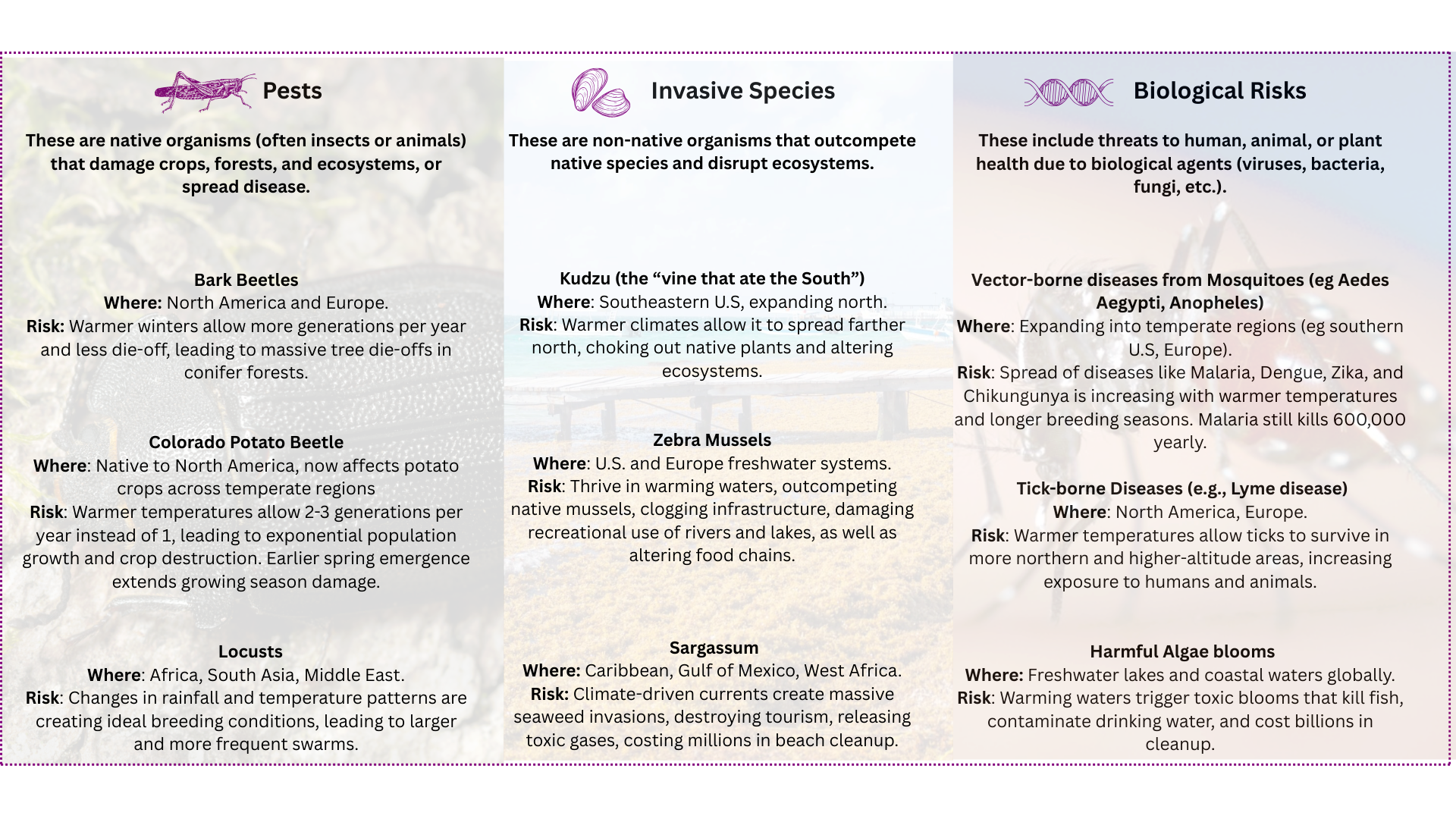
How we frame he breakdown between different PIB Risks
Current solutions are archaic, environmentally damaging, and slow with tailwinds form regulation looking to pesticides in the EU. From the outset there seems a massive opportunity for innovation.
UpRoot will look to back exceptional pre-seed and seed stage founders building technology solutions to help customers manage aquatic and terrestrial biosecurity risks across public and private markets.
We will initially operating as an angel syndicate before launching our full fund. This will help us build track record as well as testing out the dealflow environment.
When initially researching a couple of papers drew my eye as potential cornerstones from which to build UpRoot : Turbelin et al.'s 2023 work in Perspectives in Ecology & Conservation showing biological invasions are as costly as natural hazards, and the UN IPBES 2023 Assessment Report on Invasive Alien Species. These made clear that the convergence of historical biological risk, the interconnected world we live in, accompanying detrimental human behaviour, and climate change has created unprecedented threats requiring new solutions.
I imagine this journey will take us across agriculture, aquaculture, forestry, and apiaries, but also into power generation dealing with invasive mussels, biofouling on ships, and vector control.
The challenge is drawing boundaries around a PIB market when there isn't one that exists like for other climate threats. How does one begin to build a taxonomy around a risk as diversified as PIB, where threats range from vector-carrying mosquitoes to harmful algal blooms to forest pests?
That's the work ahead, and I'm excited to build it.
